ANAHITA

Artificial Vision as Causal Reconstruction

AVCR

Help a future cortical-vision system understand the world — not merely copy pixels.

AVCR is designed for future visual neuroprostheses. Smart glasses capture a changing scene. The causal engine identifies people, vehicles, obstacles, landmarks, spatial relations and a candidate safe path. A separate safety layer then decides whether a device-specific output is supported — or whether the system must abstain instead of guessing.
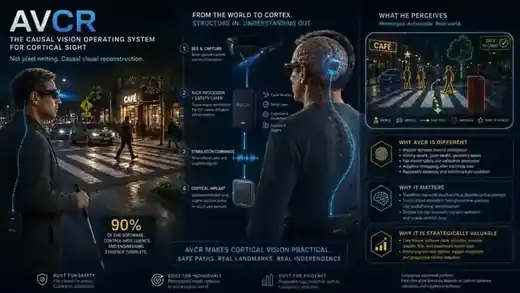
AVCR overview
Conceptual AVCR system view · world → causal understanding → safety-gated cortical output

The purpose in plain language

Turn a complicated visual world into a smaller representation that preserves what matters for the next safe action.

For a blind user, the useful question is not “Can we reproduce every pixel?” It is “Can the system preserve enough structure to distinguish a walkway from an obstacle, a person from a vehicle, a landmark from background clutter — and know when uncertainty is too high to act?”
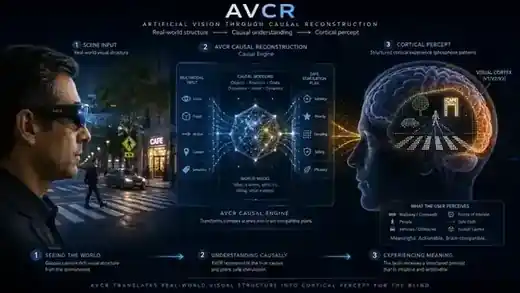
THE GOAL: real-world structure → causal understanding → meaningful, actionable, safety-aware cortical percept.
AVCR pipeline
This image shows the intended architecture directly: scene input → AVCR causal engine → structured cortical percept.

How it works

Three distinct jobs — deliberately not collapsed into one black box.

01 · SEE

Capture the real scene

Vision, depth, motion, gaze, pose and context describe what is present and how it is changing.

02 · UNDERSTAND

Reconstruct causal state

History-aware modeling preserves distinctions that can change what happens next instead of treating one frame as the whole state.

03 · ACT OR ABSTAIN

Gate the output

Only supported control plans proceed. Faults, missing evidence or excess uncertainty trigger a safe no-go or fallback.

What the representation should make easier to understand

  • Where a walkable or candidate safe path is
  • Where people, vehicles and obstacles are
  • Which landmarks or points of interest matter
  • How spatial layout and motion are changing

Why AVCR is different

  • History-aware rather than single-snapshot only
  • Geometry- and gaze-aware
  • Fail-closed safety and calibrated abstention
  • Device-agnostic control intelligence
  • Replayable evidence for engineering review
Current boundary: AVCR is a nonclinical research and engineering platform for future visual neuroprostheses. These visuals explain the intended system architecture; they do not demonstrate restored human vision, validated patient perception, clinical efficacy or regulatory clearance.

AVCR

Do not write pixels. Preserve the structure the next safe decision depends on.

The commercial and scientific focus is the software, control intelligence, safety logic, device adapters and evidence architecture required to make future cortical-vision systems more interpretable and testable.